
B1 Preliminary – Take the Plunge
Dates
2T – 8/1 – 19/3
3T – 30/3 – 21/6
Duration
2h/week (70h total)
3h/week (105h total)
Schedules
Availability can be indicated under “I’m interested” and will be taken into account when forming new groups.
Prices
(term payments)
Price Details
What's included?
(photocopies + folder)
Access to FLUP
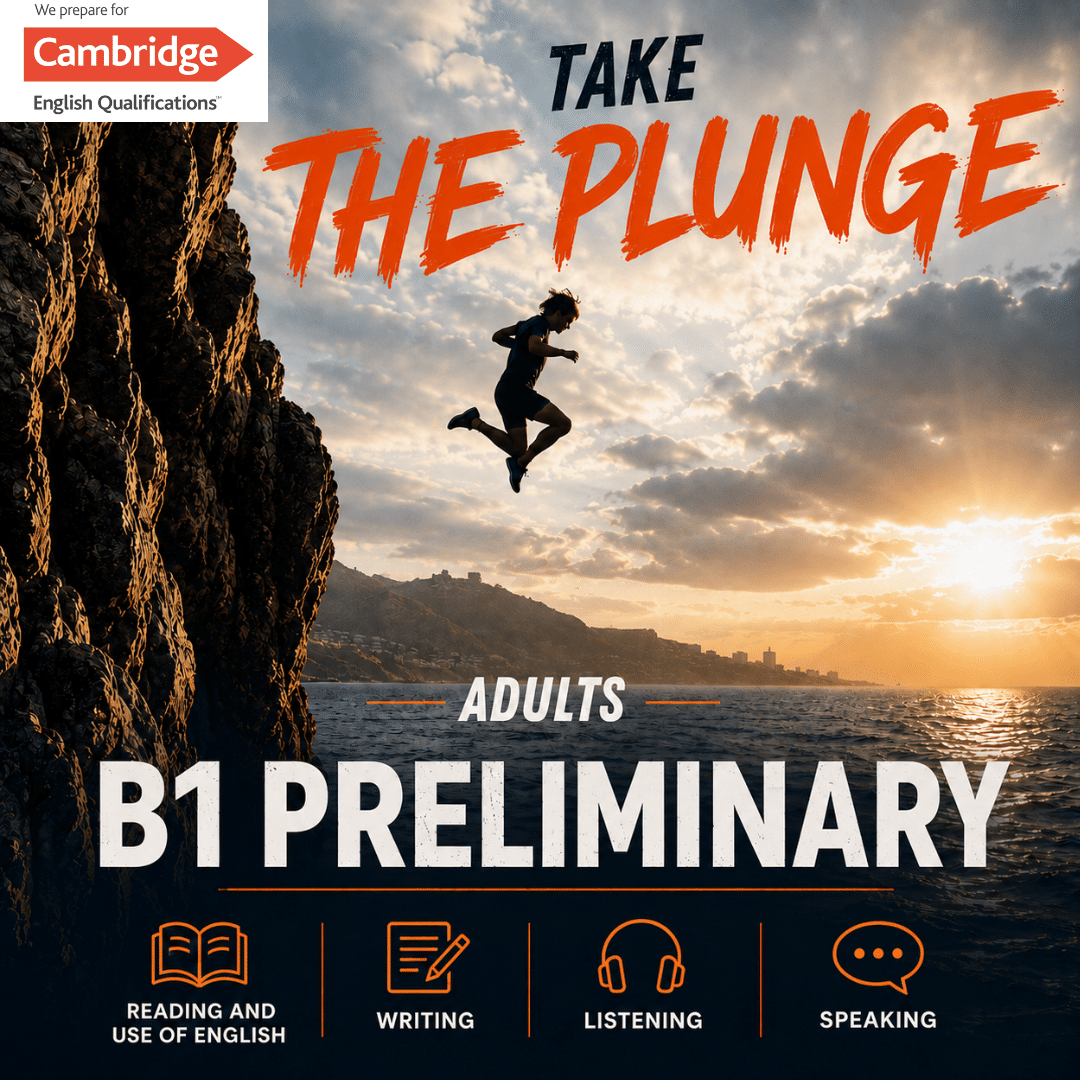
“Take the Plunge” is an English idiom that means daring to take on a new challenge — taking the next step despite any doubts or uncertainty.
B1 Preliminary is an official Cambridge exam that certifies an intermediate level of English (B1) according to the CEFR. It is an internationally recognised qualification that demonstrates that candidates have the language skills needed to communicate in everyday situations, understand familiar information and express themselves on familiar topics.
Our course is designed for adults who want to prepare specifically for Cambridge B1 Preliminary, starting from a suitable foundation in English and progressing towards the level and performance needed to approach the exam with confidence.
The course combines the development and consolidation of B1-level English with specific exam techniques and strategies, so preparation is not simply about completing practice papers, but about improving English and learning how to demonstrate that level on exam day.
Interested in the course but the timetable doesn’t work? Click “I’m interested” and let us know which times would work best.
The Cambridge B1 Preliminary preparation course is designed for adults who already have a foundation in English and want to prepare specifically to reach the required level and take the exam.
Throughout the course, students work systematically on the four parts of the exam: Reading, Writing, Listening and Speaking. They become familiar with the different task types, assessment criteria and the most effective strategies for each part, with particular attention to time management and exam technique.
Preparation is not limited to practising exam papers. We continue to develop and consolidate B1-level grammar, vocabulary, reading, listening, speaking and writing, focusing particularly on the areas that have a direct impact on each student’s performance.
Progressive practice and mock exams allow us to assess progress, identify areas that need further work and help students approach the exam with greater confidence and independence.
The course is usually offered in a 2-hour-per-week format. Depending on the level, the needs of the group and demand, we may also offer a more intensive 3-hour-per-week format, divided into two sessions, allowing more time to be dedicated both to developing B1-level English and to specific exam preparation.
The course can be taken in person at our Barcelona centre or online, depending on availability and group formation. Online groups will open once 3–4 students have been confirmed.
We work with small groups of no more than 6 students, allowing active participation, close monitoring of each student’s progress and more individualised work on the areas of the exam that need further improvement.
Homework is an essential part of the course, regardless of the format. Preparing for B1 Preliminary requires regular practice outside the classroom, so students will be expected to complete weekly Reading, Writing and Listening activities, as well as grammar and vocabulary work. This allows class time to be used to analyse difficulties, work on strategies, practise Speaking and correct the most important errors.
Throughout the course, students will also complete mock exams and practice activities under conditions similar to the real exam, allowing us to assess their progress and identify areas that need further work.
Our approach combines B1-level development with specific, progressive preparation for Cambridge B1 Preliminary. The aim is not simply to complete exam papers, but for students to understand what is assessed in each part, how to approach each type of task and which strategies they can use to improve their performance.
Throughout the course, students work systematically on Reading, Writing, Listening and Speaking, with particular attention to the challenges of each part, time management and common mistakes.
Exam practice is combined with the continued development of grammar, vocabulary, fluency, accuracy and comprehension, so that students not only learn techniques for approaching the exam but also continue improving their overall level of English.
Progress is assessed through practice activities, assignments and mock exams, allowing us to identify strengths and areas for improvement and adapt each student’s preparation as the exam approaches.
The course systematically prepares students for all four parts of Cambridge B1 Preliminary: Reading, Writing, Listening and Speaking, combining B1-level development with the strategies and techniques needed to approach the exam successfully.
Reading — 45 min
Practice with the different task types to improve reading comprehension, identifying specific information and understanding ideas, opinions and attitudes. Grammar and vocabulary needed to communicate confidently at B1 level are also developed throughout the course.
Writing — 45 min
Preparation for both parts of the Writing section: an email and a choice between an article or a story. Particular attention is paid to planning, organisation, content, register and linguistic accuracy, as well as the strategies needed to respond effectively to each task.
Listening — approx. 30 min
Practice with all four parts of Listening to develop understanding of specific information, main ideas, opinions, attitudes and meaning in a range of everyday situations. Listening also forms an important part of weekly practice at home.
Speaking — approx. 10–12 min per pair
Regular practice of all four parts of Speaking, focusing on fluency, pronunciation, vocabulary, accuracy and interaction. Students learn to answer questions, describe photographs, express and justify opinions and interact effectively with another candidate.
Exam practice and mock exams
Throughout the course, students complete timed activities and mock exams to practise under conditions similar to the real exam, assess their progress and identify the areas each student needs to strengthen.
What level is required to start the course?
Students should ideally start with an A2+/early B1 level, with a sufficient foundation to begin progressing towards B1 and specific preparation for Cambridge B1 Preliminary.
New students will need to take a level test before joining the course. This can be done online or in person at Eureka, although we recommend the in-person option as it allows us to assess the student’s level more accurately and determine whether this is the most suitable course.
Students who already study at Eureka do not need to take another level test, as we will take into account their progress and the level reached during the previous academic year.
How many students are there in each group?
We work with small groups of no more than 6 students, allowing active participation, close monitoring and more individualised work on the areas each student needs to improve.
Are the teachers native speakers?
Our team consists of native English-speaking teachers or teachers with a native-equivalent level of English, with experience in official exam preparation and teaching adults.
Is taking the exam compulsory at the end of the course?
No. Although the course is specifically designed to prepare students for Cambridge B1 Preliminary, the decision to take the exam will depend on each student’s progress and readiness.
Throughout the course, we will monitor their progress and advise students on when we believe they are ready to take the exam.
Does Eureka arrange exam registration?
Yes. Eureka is an Official Cambridge English Preparation Centre, and we can arrange exam registration for our students through our partner examination centre, Exams Catalunya.
Eureka charges a small administration fee for managing the registration. However, exam dates, availability, registration deadlines and official fees are set by the examination centre and Cambridge and are therefore outside Eureka’s control. Before registering a student, we will inform them of the available options and the corresponding cost.
Can the course be taken online?
Yes. The course can be taken online depending on demand and group formation, while maintaining the same content, objectives and specific preparation for Cambridge B1 Preliminary.
Online groups will open once 3–4 students have been confirmed.
Will there be homework?
Yes. Homework is an essential part of the preparation, and students will need to work regularly outside the classroom. Weekly tasks will include Reading, Writing and Listening activities, grammar and vocabulary work, as well as other tasks when necessary.
Will students take mock exams?
Yes. Throughout the course, students will complete timed practice activities and mock exams to become familiar with exam conditions, learn to manage their time effectively and assess their progress before the official exam.
Can the termly payment be split into instalments?
In some cases, yes. When the termly fee is relatively high, we may offer the option to split the termly fee into two payments of 50%, normally during the first two months of the term.
This is simply a payment facility and does not change the termly rate or any applicable discounts.
What happens if a student misses a class?
If a student is unable to attend a class, we will provide the information and/or materials needed to catch up, whenever possible. As these are group classes, sessions missed due to a student’s absence cannot be made up individually and are not deducted from the course fees.
Our fees are calculated on the basis of an average of 35 teaching weeks per academic year. The exact number of sessions may vary slightly depending on the day of the week and the calendar, and some groups may have an additional session. These small variations are already taken into account in the course fees.
What happens if Eureka has to cancel a class?
If Eureka has to cancel a class and we are unable to provide a substitute teacher, we will offer a make-up session. If it is not possible to reschedule the class, the corresponding amount will be deducted from the next payment, whether monthly or termly.
Are the classes entirely in English?
English will be the main language of communication in the classroom. Other languages may occasionally be used when necessary to explain exam strategies or clarify particularly complex concepts, but the use of English will be actively encouraged throughout the lesson.
Are any discounts available?
Yes. We offer Friends & Family, unemployment, university student and 65+ discounts. Full details and applicable conditions can be found in the Discounts section of this page.
Friends & Family
10% discount for each new student, plus an additional 5% for each additional student, applicable for one term.
Unemployment Discount
15% discount on the course fees throughout the academic year. Supporting documentation will be required.
University Students
15% discount on the course fees throughout the academic year. Proof of university student status will be required.
Students Aged 65+
15% discount on the course fees throughout the academic year.
Discount Conditions
Discounts cannot be combined. Where more than one discount applies, the most favourable discount will be applied.
For particularly small groups of 2 or 3 students, discounts will be subject to the viability of the group and Eureka reserves the right not to apply them.
Discounts apply to course fees and not to registration fees or other additional charges, unless expressly stated otherwise.
Contact us
Price table for the 2026/2027 academic year – (2h/week)
| Registration | 1T | 2T | 3T | Monthly (Sep-Jun) |
|---|---|---|---|---|
| 50,00 € | 260,00 € | 260,00 € | 250,00 € | 85,00 € |
Price table for the 2026/2027 academic year – (3h/week)
| Registration | 1T | 2T | 3T | Monthly (Sep-Jun) |
|---|---|---|---|---|
| 50,00 € | 385,00 € | 385,00 € | 385,00 € | 125,00 € |